
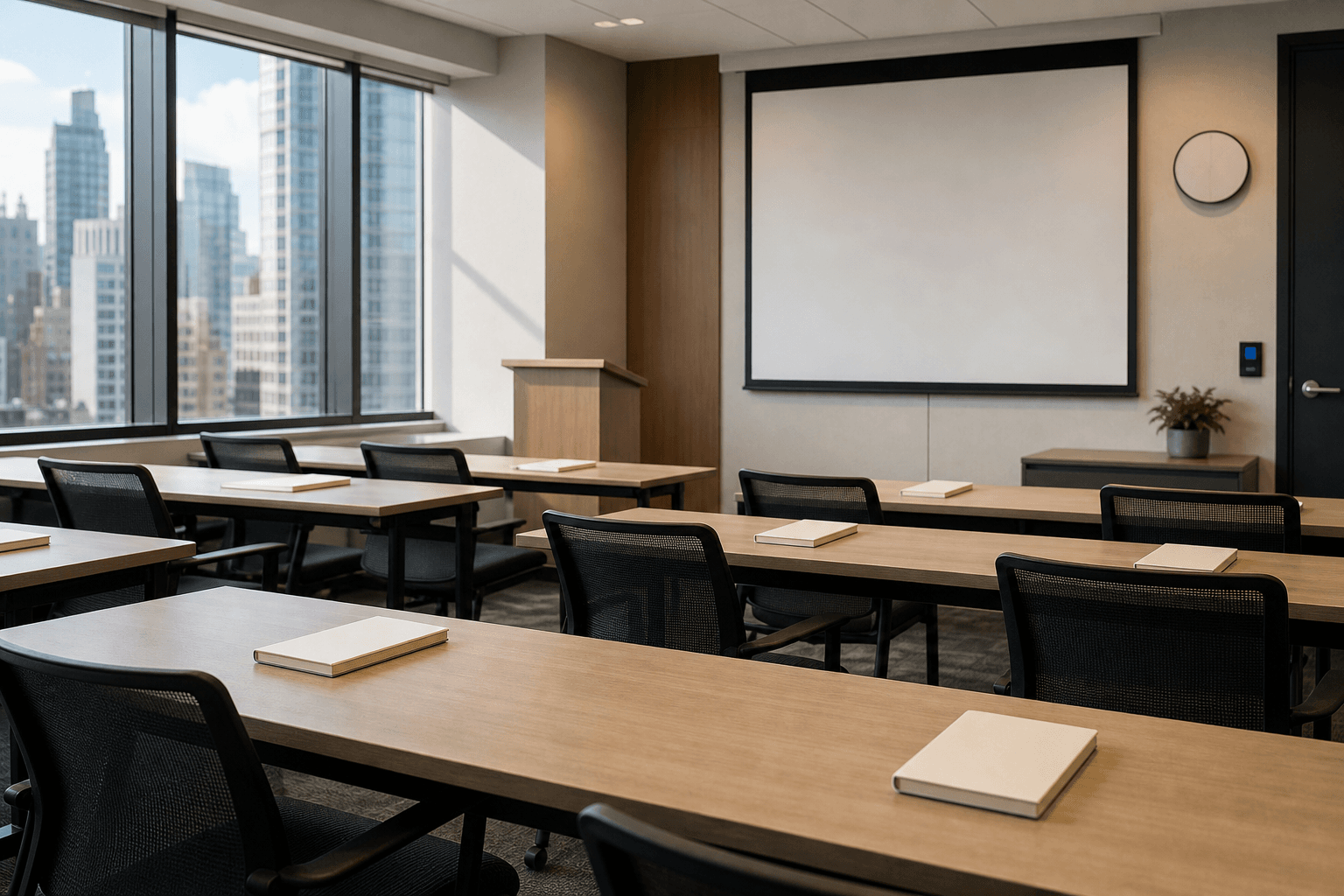
The 8 hour annual security training course is a recurring part of professional development for many New York security guards. It gives working guards time to revisit core responsibilities, examine issues that may arise on assignment, and refresh skills that can weaken when they are not practiced deliberately. Rather than treating the class as a formality, students can use it to connect prior training with real questions from the workplace. Radiant Training & Consulting, LLC offers annual in-service training as part of its New York security guard course catalog.
Why annual in-service training deserves focused attention
Initial training introduces a wide range of concepts in a short period. Once a guard begins working, daily routines may emphasize only a portion of that material. Annual training creates a scheduled opportunity to step back, review the broader role, and correct misunderstandings before they become habits.
The most useful mindset is to arrive ready to compare foundational principles with current experience. Students may now understand why a topic such as accurate reporting, access control, or emergency communication matters because they have seen how small details affect an entire shift. That experience can make the refresher more concrete than the original course.
Annual training also supports consistency. Security professionals may work at different sites with different post orders, but core expectations such as professionalism, observation, communication, and responsible escalation remain important. A refresher helps students distinguish broad professional principles from the procedures that belong to one particular assignment.
What 8 hour annual security training commonly reinforces
Course content should be understood through the current curriculum and instructor guidance, but annual in-service study generally returns to essential areas of security work. These may include the role and limits of a security guard, professional conduct, communication, observation, documentation, emergency awareness, and interaction with the public.
The value comes from revisiting how these areas connect. A guard who observes an unusual condition must decide what falls within the assigned role, communicate through the correct channel, protect the accuracy of the information, and document the event appropriately. These are not separate skills; they form a sequence.
Students should listen for distinctions. Observing is not the same as assuming. Reporting is not the same as investigating beyond one’s authority. Providing assistance is not the same as ignoring site procedure. Annual training can sharpen judgment by showing how professional boundaries apply in realistic situations.
Professional conduct and the responsibilities of the role
Professionalism is visible in routine moments: arriving prepared, maintaining attention, communicating respectfully, protecting confidential information, and following post orders. The annual course offers a chance to examine how these habits affect public confidence and site operations.
Role clarity is equally important. A security guard should understand assigned responsibilities, the chain of command, and when a matter must be escalated. Trying to solve every problem independently can create risk. So can failing to act when a required notification should be made. Training helps students think through that balance without inventing authority they do not have.
Ethical decision-making belongs in this discussion. Students can consider conflicts of interest, favoritism, requests for restricted information, and pressure to overlook a rule. Scenario-based conversation makes these issues easier to recognize before they appear on the job.
Observation and reporting as connected skills
Observation is more than looking around. It involves noticing relevant details while remaining aware of the larger environment. Training may prompt students to consider people, vehicles, objects, locations, time, sequence, and changes from normal conditions. The goal is not suspicion for its own sake; it is accurate awareness.
Reporting turns observations into information another person can use. Strong reports separate facts from conclusions, follow a clear sequence, and avoid unnecessary language. They answer basic questions without exaggeration. Students can improve by writing short descriptions from scenarios and checking whether someone who was not present could understand what occurred.
Recall exercises are helpful. After viewing or hearing a brief situation, list only what was directly observed. Then compare details with classmates. Differences reveal how attention can be selective and why contemporaneous notes, when permitted by procedure, can matter.
Communication during routine and unusual situations
Security communication must be clear, calm, and appropriate to the audience. A conversation with a visitor differs from a radio transmission or a report to a supervisor. The annual class can help students practice choosing concise language while maintaining respect.
Listening is part of communication. A guard may need to gather a person’s concern, confirm key details, and explain the next step without promising an outcome outside the guard’s control. Repeating essential information back can prevent errors, especially with names, locations, or instructions.
During unusual situations, a calm structure is useful: identify the issue, state the location, describe immediate conditions, and follow the established notification process. Students should avoid assuming that a generic classroom example replaces a site’s emergency plan or post orders. The course provides principles; the assignment provides approved procedures.
Emergency awareness and appropriate response
Annual training may revisit how guards recognize hazards and support an organized response. The emphasis should remain on awareness, timely communication, and actions authorized by training and site policy. A guard should know how to locate emergency information for the assignment and how to avoid creating additional danger.
Scenarios can include alarms, medical concerns, fire or smoke conditions, severe weather, crowd issues, or suspicious activity. For each scenario, students can ask four questions: What is directly known? What immediate risk is present? Who must be notified? What information should be documented afterward?
This framework does not produce one universal answer. It teaches a disciplined way to think while respecting the limits of the role. When a scenario depends on site-specific rules, the correct training habit is to identify that dependency and seek the approved procedure.
Access control and interaction with the public
Access control often appears routine until an exception occurs. A visitor may lack expected documentation, a delivery may arrive outside normal hours, or someone may request entry based on urgency. Consistent procedure protects both the facility and the guard from improvised decisions.
Training can reinforce how to remain courteous without abandoning requirements. Explain the process, avoid arguments, contact the appropriate person, and document the exception according to policy. Professional tone matters, but politeness does not require granting unauthorized access.
Public interaction also raises questions about privacy and information sharing. Students should understand what information they are permitted to provide and where requests should be directed. When unsure, pausing and escalating is often more professional than guessing.
How working guards can prepare for the annual course
Preparation begins with a short inventory of questions from the previous year. Think about situations that were confusing, procedures that required clarification, and skills that are rarely used. Remove names and sensitive site details from examples. The objective is to understand the principle, not disclose protected information.
Review prior course notes and any current guidance provided for enrollment. Bring materials requested by the school and arrive ready to participate. During class, mark topics that connect with your assignment and write down follow-up questions for a supervisor when the answer depends on local procedure.
Radiant Training & Consulting, LLC lists the Security 8-Hour Annual In-Service course among its security guard offerings. Students should confirm current schedules, registration instructions, and course requirements directly with the training provider before attending.
Make the refresher useful after class ends
Within a day of completing the course, summarize the most important takeaways in your own words. Separate universal professional principles from questions that require site-specific answers. If the course revealed a gap in your understanding, schedule a follow-up rather than letting the note disappear.
Create a small monthly review habit. Revisit one topic, such as report writing or communication, and test yourself with a short scenario. Annual training is more effective when its lessons are reinforced throughout the year instead of stored away until the next renewal cycle.
Keep completion records organized according to applicable requirements and employer procedures. Do not rely on memory when documentation matters. If personal or licensing information needs to be updated, use the appropriate official channel rather than assuming the training school or employer automatically handles every step.
A focused course supports stronger everyday practice
The annual class is an opportunity to slow down and examine habits that otherwise go unchallenged. Thoughtful participation can improve observation, communication, documentation, and decision-making. It can also help experienced guards share useful perspectives while remaining open to correction.
The strongest outcome is not simply remembering isolated facts on the day of class. It is returning to work with clearer questions, more consistent professional habits, and a renewed respect for following approved procedures.
To review upcoming New York annual in-service options and registration information, contact Radiant Training & Consulting, LLC and ask about the current Security 8-Hour Annual In-Service schedule.